I needed equipment for underwater shooting during my stay with Coral Cay Conservation in the Philippines so I carried out thorough research into the available options prior to the trip.
The main considerations were cost, weight (airline baggage allowance of 20kg) and image quality.
I have Canon Eos 350D and 5D Mark II cameras with 100mm f2.8 macro, 16-35mm L f2.8, 24-105mm L and 50mm f1.4 lenses and a 580 EX speedlite.
The Ikelite hard housing for the 5D Mark II is £1200 with around £300 extra for two different ports to fit different size lenses and a further £340 for an 8” dome port should I want to use a 15mm fisheye lens. A strobe light and fittings would add from about £460 upwards.
The various options are shown below.
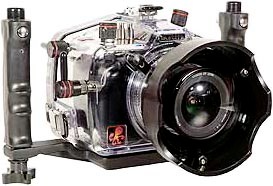
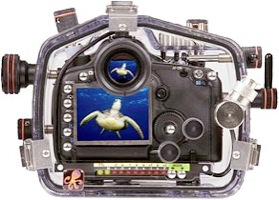
Ikelite 6871.02 hard housing – 3.25 kg without port – 3.6 kg with port
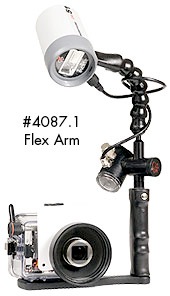
Ikelite DS51 Strobe + 4087.1 Flex-Arm + EV Controller 0.6kg = £460
The total cost for this kit would be at least £2300 with a weight of 4.2 kg. Perhaps I could go with a smaller camera and housing but it would mean purchasing a new camera and the kit to go with it. I considered the Canon Gl2.
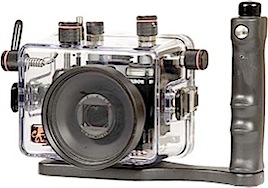
Ikelite 6146.12 housing + Canon G12 camera + 2GB SD card = £ 999.99 from Cameras Underwater at www.camerasunderwater.co.uk
Camera – 0.4 kg housing with handle and camera installed – 2.7 kg
The housing comes standard with an optical grade glass flat port which allows full use of the camera’s zoom range without vignetting. A flash diffuser is included to improve image quality when using the camera’s built-in flash to illuminate the subject.
Special conversion circuitry built in to the housing provides Canon ETTL exposure connected to any current model Ikelite DS Substrobe. The camera controls the Substrobe’s output for accurate exposure.
This option would be 1.5 kg lighter and cost up to £1300 less if the internal flash was used rather than an external strobe but I would need to add the cost of additional lenses. I would be able to shoot RAW.
Canon Powershot D10 compact camera – 190 g – £226
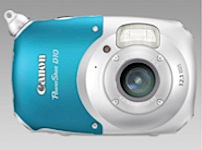
The simplest, lightest and cheapest option was to go with an underwater compact. The Powershot D10 had some excellent reviews:-
http://www.whatdigitalcamera.com/videos/reviews/344032/waterproof-digital-cameras-group-test.html
Ewa Marine U-BXP 100 SLR Camera Housing – 1.3 kg – £350 – Cameras Underwater
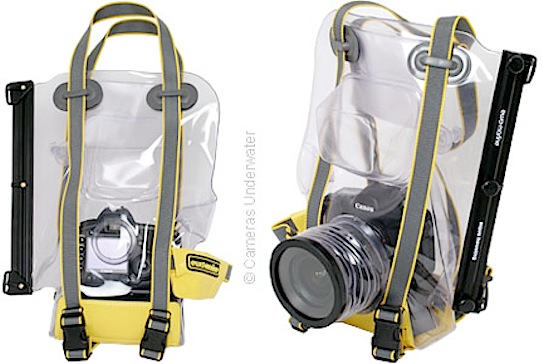
After hours and hours of research and head-scratching, I finally chose this, the flexible, Ewa Marine, waterproof bag, with which I could use the kit I already had. Not too expensive, not too heavy….and unfortunately, not too simple, as it turned out! There are different versions of this bag, this is the most expensive one which I chose so I could use the 580ex speedlite and also my 16-35 mm lens.
The U-BXP 100 is a special version of the U-BXP housing. It has a wider front glass and allows in combination with the C-A 77 adapter (supplied with the housing) and C-A 82 (available as an accessory from your dealer) adapter the use of lenses with a filter thread of 77 and 82mm. This means you can use your professional digital SLR camera like the Canon EOS 1D, 1Ds Series as wellas the Nikon D1, D2H, D2X, D200 and similar cameras, with most of the professional wideangle lenses currently on the market. This enables you to use wideangle lenses with a focal length of 16mm (full format chip) without problems. All lenses used with this housing must have a internal focus. Lenses with a smaller filter diameter can also be used in this housing as long as they have internal focus. You just need the right step-up ring. The autofocus adapter (AV110) is not included in delivery as it is not needed for this housing. If the optional BF1 lead weight is inserted into the housing, underneath the camera, it becomes even easier to reach the maximum depth. Experienced photographers have confirmed, that the auto focus and flash both continue to function perfectly. As you descend, the air is pressed into the camera. Due to this, the pressure inside the housing willremain the same as the surrounding water pressure. The dive must be started with a suitable amount of air inside the housing.
Conclusions
The bag is waterproof to over 30 metres – not a drop got through the seal and it enabled me to use the kit I had already. It is sturdy and seems hardwearing for a plastic bag but there were some problems and I found it frustrating to use. Not using a battery grip, I found the LCD screen of the Canon 5D Mark II did not line up with the viewing ‘circle.’ Crucially, the rigid seam of the bag lined up exactly where my finger needed to feel the shutter button so it was impossible to have much control. Successfully half- pressing the shutter for auto-focus or fully pressing to take the shot was rather hit-and-miss and I’m not sure I could have improved with practice. The design of the straps seems illogical – there doesn’t seem to be a way to use them to comfortably hold the bag in place, if dropped it could float away. I needed to attach different weights to the bag but it wasn’t possible to clip them in place. I had to laboriously undo each strap before threading the weights on.
The other people I was diving with used underwater compacts and I would say they took far better shots than I did and they certainly enjoyed taking them more. I was taking part in coral reef conservation and was there primarily for that purpose so the opportunities for me to dive with thephotographic equipment I had were limited. Those with the compacts were able to take them on every dive. Next time….